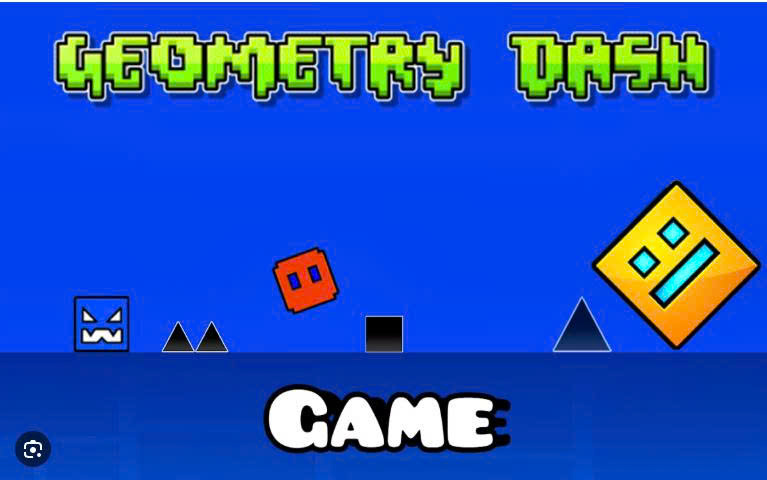
Introduction about Geometry Dash
Some games sweep you up with sprawling open worlds; others hook you with a single button. Geometry Dash belongs firmly to the second camp, and that’s precisely why it’s so addictive. At first glance, it looks almost too simple — a square icon racing forward across a colorful track, where your only real job is to jump at the right moment. Spend five minutes with it, though, and you realize the simplicity is a disguise. What looks like a casual tap-along quickly becomes a test of rhythm, memory, and nerve, and beating a level feels genuinely earned.
What Kind of Geometry Dash Game It Is
If you’re new to it, Geometry Dash is a rhythm-based action platformer. Your character — most often a cube — moves automatically from left to right, and you control nothing except when to jump. Tap, click, or press the space bar, and the cube leaps. Hold and it jumps repeatedly. Hit a spike, fall into a pit, or bump into a wall, and the level restarts immediately.
That instant restart is the heart of the experience. There’s no long loading screen, no penalty, no lost currency. You fail, you learn, you try again, and the loop is so fast that “one more attempt” turns into twenty before you notice.
The game is built around two main modes. In the official levels, you work your way through increasingly tough stages designed by hand, each with its own color scheme and soundtrack. Then there’s the community side, where players build and share their own levels using an in-game editor. This is where Geometry Dash truly explodes — you’ll find everything from gentle beginner stages to brutal “impossible” challenges that only a tiny fraction of players ever complete.
How to Actually Play Well Geometry Dash
The controls are trivial to learn and impossible to master. That gap is the fun. A few things help enormously, whether you’re completely new or stuck on a level for the hundredth time.
Learn the level, not just the moment. Geometry Dash rewards memorization. You’ll often die repeatedly at the same spot simply because you haven’t seen what’s coming. Once you know the pattern, it’s no longer a reaction test — it’s muscle memory. Most skilled players have run a level dozens of times before clearing it, and that’s normal.
Use practice mode. The game lets you place checkpoints and replay sections in isolation. It’s tempting to ignore this and grind the full level over and over, but practice mode is far more efficient. Break a hard section down, master it, then stitch the pieces together.
Consider the audio. The music isn’t just decoration — the obstacles are usually timed to the beat. When you’re struggling, try playing with sound on and listening for the rhythm rather than staring intensely at the screen. Many players find that the jump timing clicks naturally once they sync with the track.
Change your icon if it helps. It sounds silly, but a different character skin or a trail effect can make your position easier to read, especially in visually busy sections. Some players genuinely time their jumps better with a smaller or more distinct icon.
Keep your attempts short when frustrated. Tilt is real. If you’ve died twenty times in a row on the same jump, step away for a few minutes. You’ll almost always clear it faster after a break than you would by forcing another hundred tries.
Don’t skip the easy levels. It’s tempting to jump straight into the hardest community stages to look impressive, but the early official levels teach you the fundamentals — timing, pattern recognition, patience — that you’ll rely on later. There’s no shame in building up.
Where the Real Joy Lives
The magic of Geometry Dash isn’t in any single level. It’s in that moment when a sequence you’ve failed dozens of times suddenly flows by effortlessly, your fingers moving before you even think. Or when you finally reach the end of a level you’ve been chasing for weeks, and the screen erupts in celebration.
The community adds another layer entirely. Watching someone else beat a level you’ve been stuck on, or discovering a creative player-made stage you’d never have imagined, keeps the game fresh long after you’ve exhausted the official content. Because levels are free to play and endlessly shared, there’s effectively no finish line.
Conclusion
Geometry Dash is proof that you don’t need complex mechanics to make something unforgettable. One button, a steady beat, and a willingness to try again are all it asks for. It’s the kind of game you can pick up for five minutes or sink an entire evening into, and it rewards exactly the qualities that make any skill satisfying to learn: patience, attention, and persistence.
So if you’ve never given it a shot, start with the earliest levels and just enjoy the rhythm. And if you’ve already been playing for years, you know the feeling — that impossible jump you’ve attempted a thousand times, finally yours. Either way, the next attempt is always worth making.
